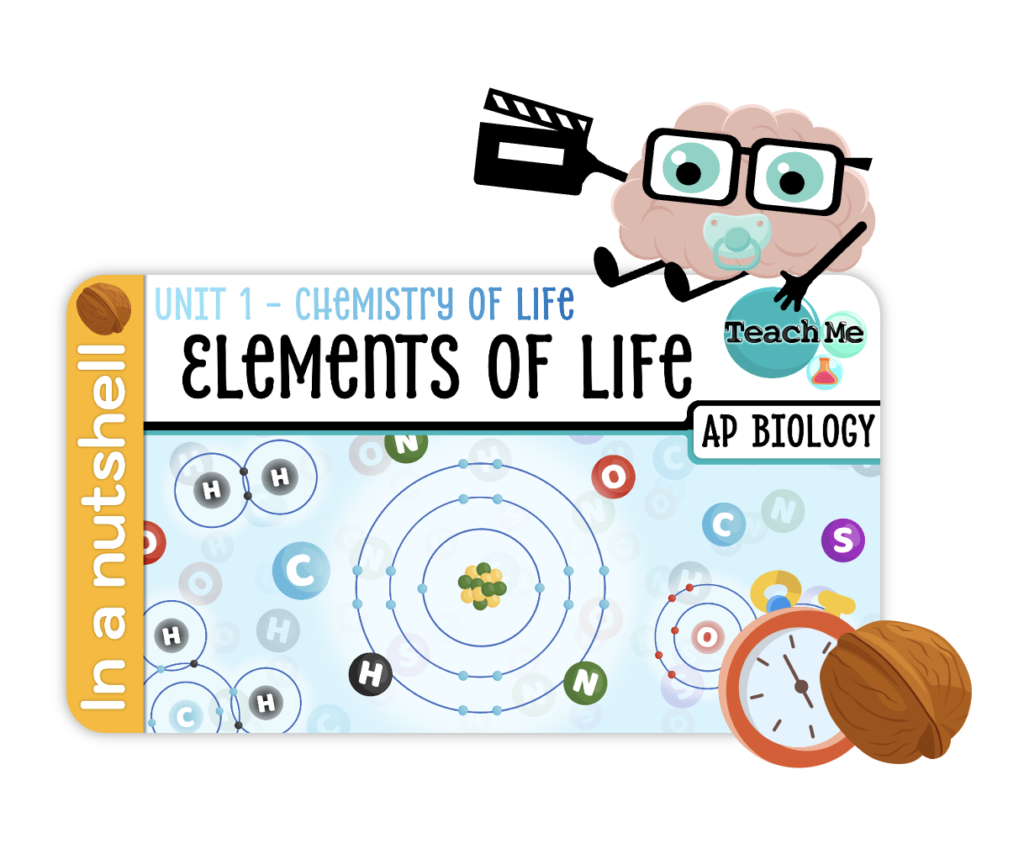
You thought you are “special”. Think again. You, me, that squirrel outside, and the mold on your forgotten leftovers? We’re all built from the same cosmic leftovers. Sure, the universe is full of stuff, but only a select few elements made the cut for the biological VIP section.
In this video, we break down the elemental elite to show you:
The “Big Four” Heavyweights: Why Carbon, Hydrogen, Nitrogen, and Oxygen are the ultimate squad goals (and why you’re basically 96% air and fossil fuel).
The Trace Element Tattletales: The tiny amounts of calcium and iron that sound boring but are literally the reason your bones don’t turn to jelly and you don’t pass out when you stand up.
The Chemistry of Sass: Why electrons are the dramatic divas of the atom world, and how their drama creates the bonds that hold your life together.
The Survival Guide to the AP Bio Exam: How to spot the “element” questions from a mile away and not confuse your isotopes with your ions (we’ve all been there).
You’re made of stars… and also a lot of oxygen that used to be in a dinosaur’s lungs. We’ve got the answers to your burning (and bonding) questions.
You are what you eat — but really, you’re what your cells build from what you eat. And what they’re building is absolutely massive. This is your crash course on Macromolecules for AP Biology:
The “Monomers to Polymers” Pipeline: Why linking tiny Lego bricks together is basically the entire plot of your cellular existence (and why your body is just one giant dehydration synthesis reaction).
Carbs, Lipids, Proteins, Nucleic Acids—The Fab Four: Which ones will give you energy, which ones will build your muscles, and which ones are just there to store your genetic secrets (spoiler: it’s DNA, you dramatic double helix, you).
How to NOT mix up your glycosidic, peptide, and phosphodiester bonds: Your exam paper is watching. We’ve got the tricks to keep them straight.
They’re huge, but your stress about them doesn’t have to be. We’ve got the answers (and the terrible molecule puns) to get you through Unit 1.3
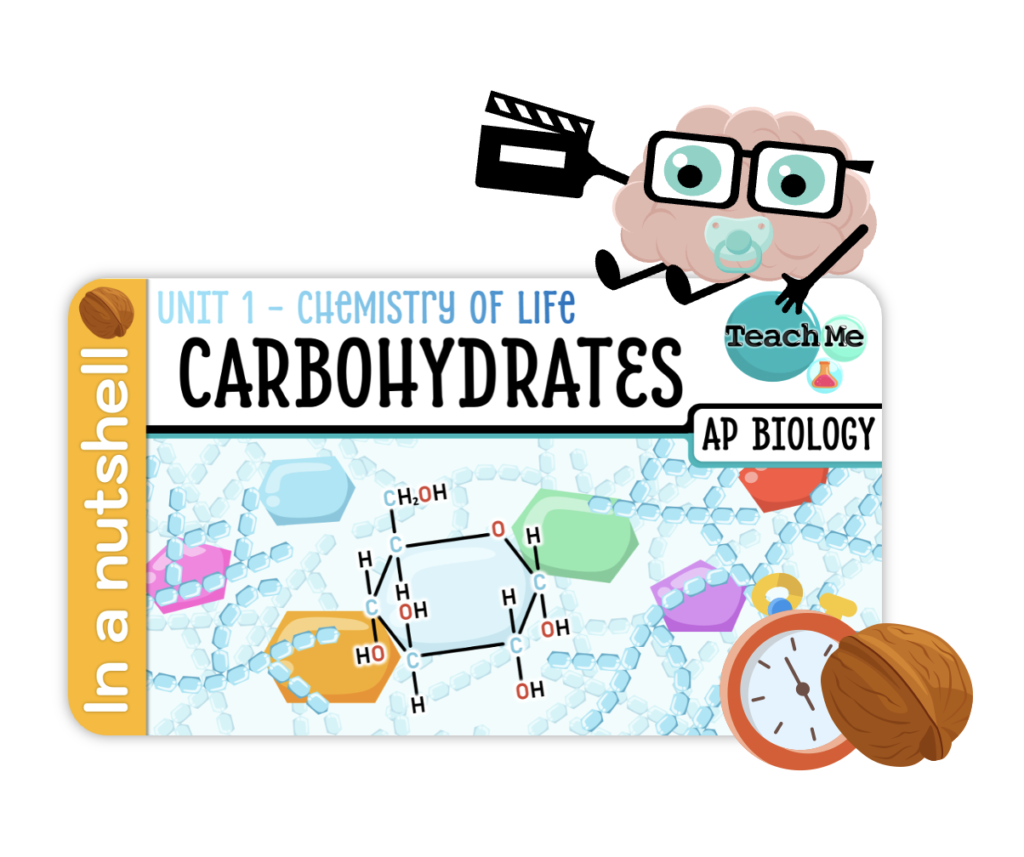
They’re not just pasta—although, let’s be real, pasta is amazing. Carbs are your body’s favorite snack, its primary fuel source, and honestly? A structural flex. Unwrap the surprisingly juicy (and slightly sticky) science of carbohydrates for AP Biology. No more crying over your textbook.
In this video, we’ll make it painfully clear—in a fun way:
Glucose structure – spoiler: it looks like a molecular mood ring.
Glycogen vs. starch vs. cellulose – one is your energy backup, one is french fry fuel, and one is basically plant armor. Guess which one you can’t digest (hint: don’t eat the tree).
Why cellulose is the ultimate plant superhero – it’s strong, it’s fibrous, and it’s the reason salads don’t instantly collapse into sad green goo.
Stop cramming like a desperate squirrel. Start understanding the energy of life—with 70% less confusion and 100% more bad carb-related puns.
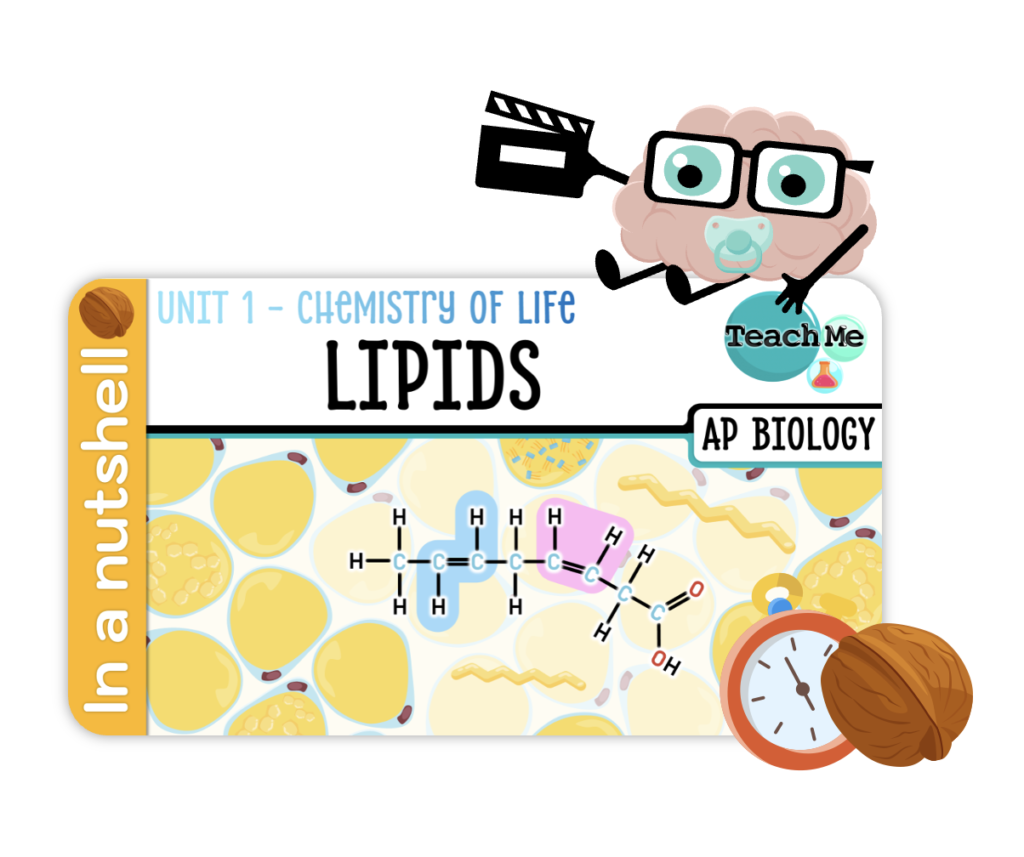
They’re not just fats (that give you a triple chin)—they’re insulation, protection, and a powerhouse of energy storage. Dive into the hydrophobic world of Lipids for AP Biology. This video cuts through the grease to explain:
Triglycerides: The structure of a triglyceride and why it’s so efficient for storage (hint: it’s the ultimate survival backpack).
Saturated vs. Unsaturated: The undeniable difference between saturated & unsaturated fats (no confusion!—just look for the kink).
Phospholipids: The amazing dual-nature of the phospholipid and why it’s the foundation of every cell membrane (they hate water, but love their job).
Steroids (The Plot Twist): How cholesterol (a lipid with no fatty acids!) keeps your cell membranes stable and prevents them from freezing or falling apart.
Understand the molecules that shape your cells and store your energy.
TIMESTAMPS
STUDY RESOURCES
00:00:00 – Intro
00:00:15 – Overview Of This Video
00:02:57 – Types Of Lipids
00:06:18 – Triglycerides Function
00:15:15 – Fatty Acids & Glycerol Structure
00:22:14 – Saturated V.S Unsaturated Fatty Acids
00:27:25 – Glycerol + Fatty Acids = Triglyceride
00:35:23 – Lipids DO NOT Have Monomers Or Polymers
Forget everything you know about “simple” blueprints. DNA is the original, 3-billion-year-old instruction manual for a DIY project that is you—and it’s written in a language so secret that the cell needs three different translators (hi, RNA!) just to get the job done.
This video dives into the world of genetic information, where the molecules are fragile, the pairing rules are strict, and one molecule (ATP) acts as the cash that pays for the whole chaotic operation:
The Nucleotide: The building block with a sugar, a phosphate, and a nitrogenous base. It’s the only Lego brick that can also write a novel.
DNA (The Double Helix): Why two strands? Data backup. We cover the anti-parallel rails and the strict dating rules: A with T, G with C. No exceptions. No drama.
RNA (The Underpaid Interns): DNA is the boss who stays in the office. RNA does the actual work.
The Genetic Code: UGG always means Tryptophan. Always. Bacteria, blue whale, or human—same code. Proof we’re all just different hacks of the same source code.
ATP (The Cellular Energy Drink): Three phosphates = fully charged battery. Snip one off? Boom. Energy. It’s the only currency the cell accepts.
Watson, Crick & The Math Guy: In 1953, Watson and Crick dropped into a pub and announced they’d solved DNA (humble brag). But they stood on the shoulders of Erwin Chargaff, who noticed that no matter the species—human, mushroom, or whale—A always equals T, and G always equals C. Thanks, Erwin. You’re the real MVP.
Understand how your cells store the instructions for you, how they read them without ripping the pages, and what pays for the whole mind-blowing process.
Forget “protein shakes”. Proteins are the original multi-tools of life—they build you, power you, defend you, and control you.
But they’re also divas with a fragile ego that can’t handle a little heat or pH change:
Uses of Proteins: More Than Just Muscle: Are they a building block (structural, enzymes, antibodies)? Absolutely. Are they a last-resort energy source? Sadly, yes—your body will burn its own architecture in a pinch.
Amino Acids: The 20-Letter Alphabet of Life: Meet the squad of organic molecules with an amino group, a carboxyl group, and a personality-defining R group.
The Condensation Reaction: How amino acids perform a molecular handshake, losing a water molecule to form a dipeptide, then a polypeptide chain. This is how the blueprint becomes a 3D machine.
The Four-Act Drama (in one breath): Primary = boring chain of amino acids. Secondary = local coiling (spiral staircases and dad’s golf pants). Tertiary = folds into a functional 3D glob. Quaternary = multiple subunits forming the molecular Avengers.
Denaturation: The Great Unraveling: Why cooking an egg solidifies it, why a fever is dangerous, and why lemon juice “cooks” ceviche. It’s the process of destroying a protein’s delicate 3D shape, turning a precise tool into a useless, tangled mess.
Learn the language of life, one amino acid at a time.
TIMESTAMPS
STUDY RESOURCES
00:00:00 – Intro
00:00:15 – Overview Of This Video
00:00:56 – Levels Of An Organism
00:02:40 – What Are Proteins?
00:11:40 – Amino Acids, Peptide Bond & Polypeptide